Summer bike fit top tips
Get the most out of yourself and your bike with this step-by-step guide from Team Sky and official bike fit supplier Retül.
Last Updated: 24/06/14 11:26am
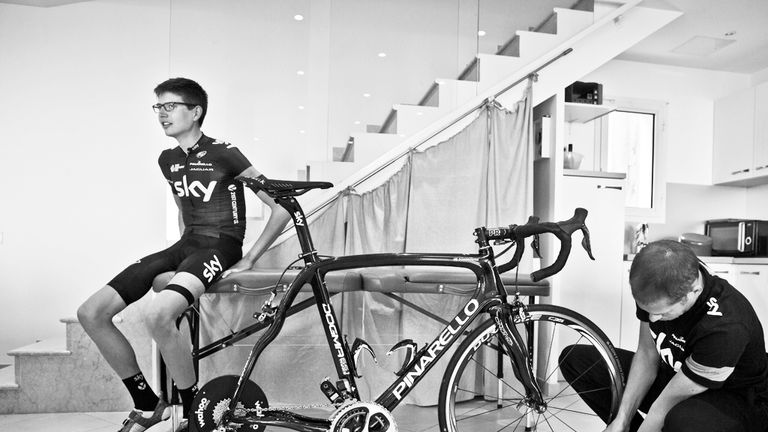
A correct riding position will help you perform well on your bike and reduce the likelihood of injury. Seeing a bike fit professional is the best way to achieve your ideal position, but there are also several simple techniques you can do at home to ensure you are on the right track.
Todd Carver from Team Sky's official bike fit supplier Retül shares a few tips here for you to check your fit. You will need a stationary turbo trainer, a front wheel block, a spirit level, a marker or stickers, and metric allen keys.
Prepare the bike
• Pump up the tyres to recommended pressure.
• Set the bike in the turbo trainer according to manufacturer' recommendations.
• Place a front wheel block under the bike’s front wheel so the bike is level to the horizon. Check this by placing one end of a spirit level in the middle of the rear axle, and the other and toward the front axle. Adjust the front wheel height until the axles are level.
• The bike should now be stationary, stable, level to the horizon and vertically straight (not leaning to one side or another as you sit on it).
Foot position and cleat placement
• With your cycling shoes on, squat down with your weight on the balls of your feet. Locate the first (inside) and fifth (outside) metatarsal heads. These bones are easily found directly behind the big toe and little toe. Mark these points with a pen or stickers.
• Take your shoes off and attach cleats to the shoe so that the pedal spindle (marked on most cleats) bisects the first and fifth metatarsal heads (that you just marked on your shoe). This is a standard position for cleat settings.
• Set lateral adjustment of the cleat in the middle of the available range.
• Set the rotation angle of the cleat so the shoe points straight forward. Check this by hanging your shoes by the rear of the cleats from a flat tabletop. This creates a good visual to determine if the cleats are set straight.
• Tighten cleat bolts to the manufacturer's recommended settings.

Saddle position
• Set the saddle in the middle of the rails.
• Set saddle height at the low end of the available range.
• Adjust saddle angle so that the saddle is level to the ground as measured from the front two-thirds of the saddle. For shaped or anatomical saddles, the rear of the saddle will rise above the front of the saddle for proper sit bone support and provide relief to the anterior soft tissue. Saddle angle is subject to personal preference and variability between saddle brands.
• Mount the bike and sit squarely on the saddle. Hang both feet straight downward with knees fully extended.
• Adjust saddle height higher until your heels barely scrape the pedals at the bottom of the pedal stroke with the knee fully extended.
Handlebar position
• For road-style handlebars, the main portion of the grip (or hood) should be angled slightly upward to facilitate a neutral wrist angle when riding. Make sure you can reach your brake levers comfortably from both the hoods and the drop portion of the handlebar.
• Most stems can be positioned either upward or downward. Start with the stem angled downward.
• Place the spirit level on the middle of the saddle and extend it outwards over the top of the handlebar. For a competitive or racing road bike position, the top of the handlebar should be at least a full fist width below the mid-point of the saddle (most fists are about eight centimetres). For a performance road position, the top of the handlebar should be five to six centimetres below the mid-point of the saddle. For a recreational road bike position, the top of the handlebar should be level with or a few centimetres below the mid-point of the saddle.
• If adjustment of the stem height is available with headset spacers, adjust accordingly. If you cannot raise your bars high enough with headset spacers, flip the stem.
• Once you have set the bar height, mount the bike and ride with your hands positioned at all of the contact points of the handlebar.
• Adjust stem length (by using a different stem) and fine tune bar height to arrive at your desired position.
• To avoid discomfort or injury, start with your bars higher, and a shorter reach with respect to the saddle. As you gain comfort in that position and if you desire more speed, slowly progress to a lower and longer position.
These tips are a starting point for proper positioning. A dynamic bike fit is the best way to find your optimal position on the bike, as this process considers your individual biomechanics, goals and the adjustable ranges of your bike. To find a certified Retül bike fitter near you, visit www.retul.com.
You can learn more about the intricacies of finding your correct bike position in far more detail by picking up a copy of Phil Burt's new book Bike Fit HERE. Phil has worked with Team Sky's British riders in a consultancy role and continues to work at Head Physiotherapist with the Great Britain cycling team.