Update
UEFA Nations League: Format, rules, promotion and relegation explained, and how it affects Euro 2028 qualifying
The 2026/27 UEFA Nations League has reached the knockout stages, with Portugal defending their title and England chasing a first triumph; but how does the competition work, what are the promotion and relegation rules, and what changes from 2028/29?
Friday 13 November 2026 08:51, UK
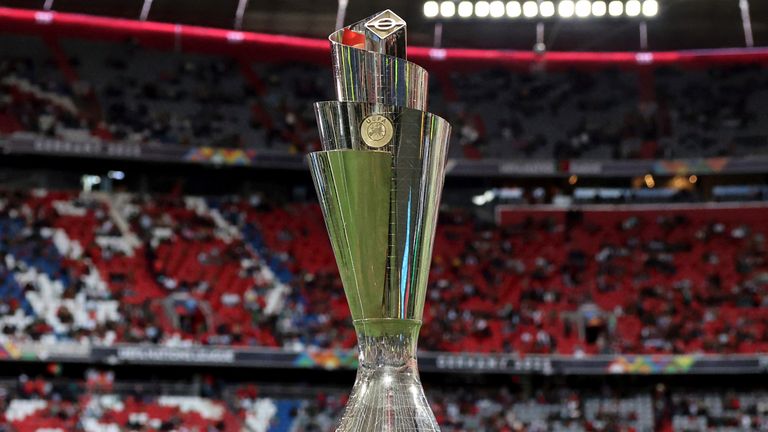
The UEFA Nations League is back for its fifth edition, with 54 European countries competing for silverware, promotion and a potentially crucial route to Euro 2028.
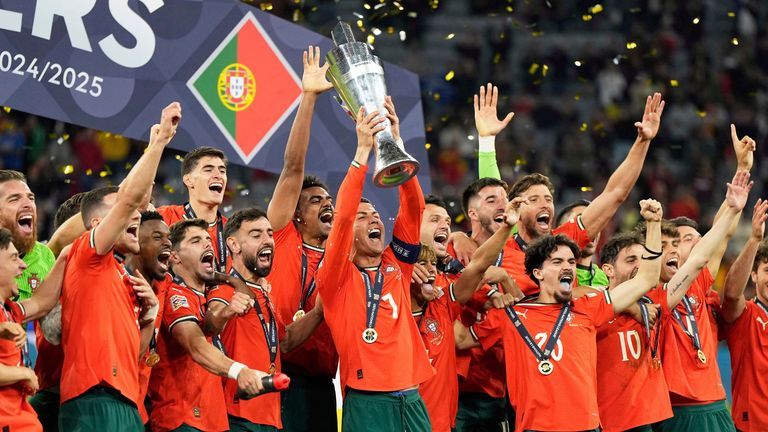
Portugal are the defending champions after beating Spain on penalties in the 2025 final, while England are hoping to go one better in this year's competition.
Thomas Tuchel's side have secured their place in the quarter-finals after finishing top of their group, with an impressive victory over Spain in Madrid confirming their position.
The knockout-stage draw has now been completed, with Norway awaiting England in the quarter-finals and either Belgium or Germany potentially standing between the Three Lions and a place in the final.
But there is more than a trophy at stake. Results can determine which division teams compete in during the next campaign, while performances could also have a significant impact on qualification for the European Championship.
From how the format works to the promotion and relegation rules, here's everything you need to know about the UEFA Nations League.
What is the UEFA Nations League?
The UEFA Nations League is an international competition involving Europe's national teams, designed to replace many of the traditional international friendlies with competitive fixtures.
First introduced in 2018, the tournament gives nations the opportunity to compete against teams of a similar standard, with promotion, relegation and a trophy on offer.
The competition is divided into four leagues - A, B, C and D - with League A containing the highest-ranked nations.
Portugal are the most successful team in the competition, having won the title twice, in 2019 and 2025.
France and Spain have also lifted the trophy, in 2021 and 2023 respectively.
How does the Nations League work?
The 2026/27 Nations League featured 54 nations divided into four leagues.
Leagues A, B and C each contained 16 teams, split into four groups of four. League D consisted of six teams, divided into two groups of three.
Teams played each opponent in their group twice, home and away, with points determining the final standings.
Three points were awarded for a win and one for a draw.
The top two in each League A group qualified for the quarter-finals, with the winners of those ties progressing to the Nations League Finals in June 2027.
The bottom sides and teams finishing in other promotion and relegation positions face a different challenge, with their performances determining which league they compete in during the next edition.
Who will England face in the Nations League quarter-finals?
England will face Norway in the Nations League quarter-finals after the draw on November 20 confirmed the last-eight ties.
Thomas Tuchel's side finished top of Group A3 with 15 points from six matches, including a dramatic 3-2 victory over Spain in Madrid.
Their reward is a meeting with Norway, who finished runners-up behind Portugal in Group A4.
It will be a repeat of their 2026 World Cup quarter-final, when England beat Norway 2-1 after extra-time, with Jude Bellingham scoring the decisive goal to send the Three Lions into the semi-finals.
Norway will be looking to turn the tables this time around, with Erling Haaland and Martin Odegaard among the standout names in their squad.
England will travel to Norway for the first leg, before hosting the return fixture at Wembley.
The other quarter-final ties are:
Spain vs France
Netherlands vs Portugal
Belgium vs Germany
Who could England face in the Nations League semi-finals?
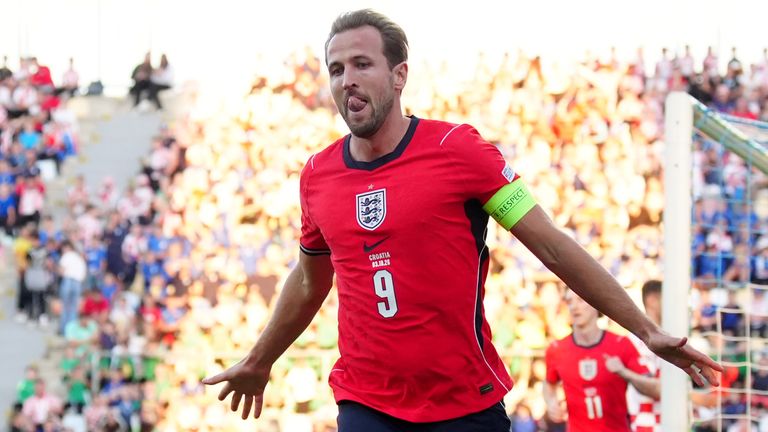
Should England overcome Norway over two legs, they will face either Belgium or Germany in the semi-finals.
The two nations have been drawn against each other in the other quarter-final on England's side of the draw.
Belgium finished runners-up in Group A1 behind France, while Germany topped Group A2 after finishing ahead of Netherlands and Greece.
It means England know their potential route to the final, with a meeting against either nation awaiting them should they progress beyond Norway.
On the opposite side of the draw, Netherlands will face Portugal, while Spain take on France. The winners of those two ties will meet in the other semi-final.
Unlike the quarter-finals, the semi-finals will be one-off matches rather than two-legged ties.
What are the Nations League quarter-final and semi-final dates?
The League A quarter-finals, alongside the League A/B and League B/C promotion and relegation play-offs, will take place during the March 2027 international break.
The key dates are:
First legs: March 25-27, 2027
Second legs: March 28-30, 2027
Semi-finals: June 9-10, 2027
Third-place play-off: June 13, 2027
Final: June 13, 2027
The four quarter-final winners will progress to the Nations League Finals, which will feature two semi-finals, a third-place play-off and the final.
The semi-finals will be played as single matches, with extra-time and penalties available if required.
Where will the Nations League final be held?
The 2027 UEFA Nations League Finals will take place between June 9 and June 13, 2027.
The host nation and stadiums are yet to be confirmed by UEFA.
The four teams that progress through the quarter-finals in March will compete for the trophy, with the semi-finals, third-place play-off and final deciding the champions.
The four semi-finalists will be invited to submit bids to host the final tournament.
How does promotion and relegation work?
Promotion and relegation are central to the Nations League, giving teams something to play for throughout the group stage, regardless of their position in the rankings.
The four group winners in League B will be promoted directly to League A, while the four group winners in League C will move up to League B.
Teams finishing bottom of their respective groups also face the prospect of dropping down a division.
However, the 2026/27 campaign features a slightly different system as UEFA prepares to change the competition format for 2028/29.
The two lowest-ranked fourth-placed teams in League A will be automatically relegated to League B.
The other teams involved in the League A/B promotion and relegation battle will contest play-offs.
These will involve the four runners-up from League B against the two lowest-ranked third-placed teams and the two highest-ranked fourth-placed teams from League A.
The winners will play in League A in 2028/29, with the defeated teams competing in League B.
A similar system operates between Leagues B and C, with the four bottom-placed teams in League B facing the four runners-up from League C.
The winners will play in League B in the next edition, while the defeated teams will drop into League C.
What were the Nations League knockout-stage and play-off draw results?
The UEFA Nations League knockout-stage and play-off draw took place in Nyon, Switzerland, on Friday November 20, 2026.
The draw confirmed all four League A quarter-final ties, alongside the promotion and relegation play-offs between Leagues A and B, and Leagues B and C.
Quarter-final draw
Spain vs France
Norway vs England
Netherlands vs Portugal
Belgium vs Germany
The quarter-finals will be played over two legs, with the seeded group winners playing the second leg at home.
Semi-final pathway
Netherlands or Portugal vs Spain or France
Belgium or Germany vs Norway or England
The semi-final pathway was also confirmed, meaning England know they will face either Belgium or Germany should they progress beyond Norway.
League A/B promotion and relegation play-offs
Bosnia and Herzegovina vs Denmark
Hungary vs Serbia
Republic of Ireland vs Croatia
Slovenia vs Wales
League B/C promotion and relegation play-offs
Cyprus vs North Macedonia
Estonia vs Romania
Faroe Islands vs Georgia
Belarus vs Israel
The play-offs will also be contested over two legs during the March international break.
What about the home nations and the Republic of Ireland?
The Nations League has provided plenty of challenges for the five British and Irish nations.
England have qualified for the League A quarter-finals after finishing top of their group, while Wales and the Republic of Ireland must navigate promotion and relegation play-offs.
Wales will face Slovenia in the League A/B play-offs, while the Republic of Ireland have been drawn against Croatia.
Both will need to win their two-legged ties to compete in League A in the 2028/29 edition.
Scotland and Northern Ireland competed in League B, with their group-stage performances determining their respective positions in the next competition.
What is changing in the Nations League from 2028/29?
The 2026/27 Nations League is the final edition to feature four divisions.
UEFA has approved a change to a three-league format for the 2028/29 competition, meaning League D will be scrapped.
All six teams currently competing in League D will automatically move up to League C.
The new structure will feature three leagues, each containing 18 teams split into three groups of six.
Teams will play six matches in the league phase, with the revised format designed to create a more streamlined competition.
The composition of each division will be determined by results in the 2026/27 Nations League.
League A will contain the eight quarter-finalists from the current edition, the two highest-ranked third-placed teams from League A, the four League B group winners and the four winners of the League A/B play-offs.
League B will include the two lowest-ranked fourth-placed teams from League A, the four defeated teams from the League A/B play-offs, the four third-placed teams from League B, the four League C group winners and the four winners of the League B/C play-offs.
League C will consist of the four defeated teams from the League B/C play-offs, the eight teams finishing third and fourth in League C, and the six teams currently in League D.
Does the Nations League affect Euro 2028 qualifying?
Yes.
The Nations League will play an important role in the qualification process for Euro 2028, which will be hosted by England, Scotland, Wales and the Republic of Ireland.
The final Nations League rankings will determine the seeding of nations for the European Championship qualifying draw.
The competition will also offer a potential second chance to reach the tournament through the play-offs.
Twenty-four teams will compete at Euro 2028. Twelve qualifying group winners and the eight best runners-up will secure automatic places, with the remaining runners-up entering the play-offs.
Nations League group winners who fail to finish in the top two of their Euro 2028 qualifying group will also be eligible for a play-off place.
Those places will initially be allocated to the best-ranked group winners from Leagues A, B and C. If additional places are required, they will filter down to the next-highest-ranked eligible teams.
The system means a strong Nations League campaign could prove decisive for countries who struggle in the traditional qualifying process.