The art of darts
Friday 4 February 2011 16:17, UK
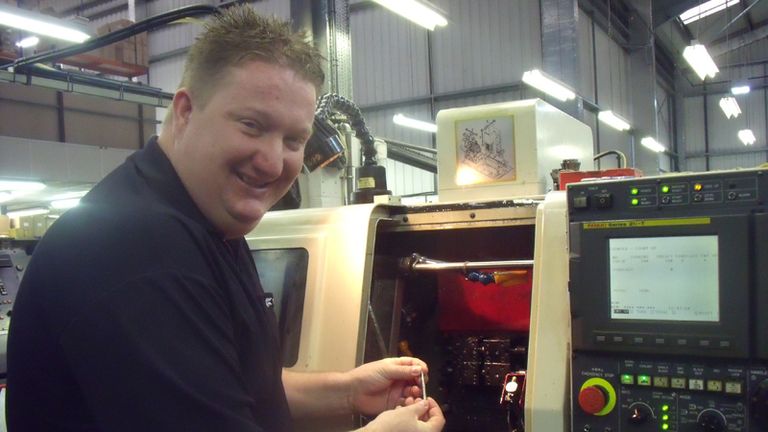
Ever wondered how darts are made? Colin Lloyd takes us to the factory that creates his precision arrows.
Jaws shows us how professional darts are created
Who'd have thought that the same technology that is used in nuclear submarines would be used to make darts? That's one of the fascinating discoveries we made when Colin "Jaws" Lloyd invited skysports.com to the Target Darts factory in Essex to discover how they make the missiles that have taken him to the top of the game. The former world number one and inaugural member of the Premier League took us on a tour of one of the few dedicated darts factories in the UK, where millions of arrows are produced every year for both PDC stars and pub players. And the technology, which has also been used to make parts for submarines, defies the stereotype that a dart is just a chunk of metal that you lob at a board... there's much more to it than that! "A dart is not just a piece of metal. Everyone needs to have something specific to what they're doing," Colin explained. "It's to do with how you hold the dart, the weight of the dart, the type of shaft you use, the design of the flight and even the thickness of flight you use. People just think it's a dart, but they don't know what goes on behind the scenes." So let's go behind the scenes and see what goes into the making of a high-quality set of darts....Building the barrel
If you've watched the sport on TV, you'll no doubt have heard Sid Waddell use the phrase "ticking tungsten" - and that's because it's the main metal used to make darts. The factory imports millions of chunks of tungsten from China, all approximately two inches long and about a centimetre in diameter, ready to be transformed into arrows. Other metals are mixed in, but the more tungsten you use, the tougher the dart. The first stage of the process sees a tungsten bullet fed into a special C&C Machine, a huge and seemingly magical device that forms the barrel. This is the main body of the dart, which is gripped by the thrower. The machine can tailor the grooves to a player's specific requirements, which is important because the professionals like to grip it in their own, specific ways. "The grip is very important. I need the grip and the grooves to be right for the three fingers I have on the barrel. I've thrown the same way since I was three years old, so I need to know I've got the right type of grip on every dart I use."Cleaning up afterwards
 The perfectly-formed barrels that emerge are quite wet and oily, so are fed into an ultrasonic machine to dry them out. This, as Colin observes, looks like a glorified chip fryer.
The lower end ranges are then painted and polished before being put into a "knurling machine", which creates the cut - or knurl - that you see at the front of a barrel. However, professional darts don't need to be polished as they are machined to perfection in the first place. Colin observes that this sort of perfection is important in top-level sport.
"Look what happened to Stephen Hendry when his snooker cue was smashed to smithereens. He won seven world titles with that cue, but he's never been the same since."
The perfectly-formed barrels that emerge are quite wet and oily, so are fed into an ultrasonic machine to dry them out. This, as Colin observes, looks like a glorified chip fryer.
The lower end ranges are then painted and polished before being put into a "knurling machine", which creates the cut - or knurl - that you see at the front of a barrel. However, professional darts don't need to be polished as they are machined to perfection in the first place. Colin observes that this sort of perfection is important in top-level sport.
"Look what happened to Stephen Hendry when his snooker cue was smashed to smithereens. He won seven world titles with that cue, but he's never been the same since."
Styling the shaft
The shaft is the section of the dart between the barrel and the flight and is usually made out of aluminium. The Target Darts factory can produce several hundred different types of shaft all cut in different ways. Colin needs these to be mass produced to high quality so he can replace his shaft at each tournament. "I use the same barrel for most of the year, but I change the shaft and the flights regularly. Under the heat of lights in tournaments the stem will warp a little bit and some people don't notice that, but I do. They're not cheap but luckily the company will give me the equipment I need. It's like footballers, who take seven sets of boots to a game!"Making the points
The point of the dart (the bit that sticks in the board) is usually made from steel and different players have different preferences over their length. These are screwed into the barrel, but Colin is unique because the barrel and the point on his darts are made from the same piece of metal. This groundbreaking "all-in-one" dart gives him tungsten from point to tip and he hopes that gives him an advantage over his rivals. "It makes the dart more aerodynamic. It's very sleek and the balance is fantastic. When Target came up with the concept I took it home and tried it and I was really happy to use them. I was using them in tournaments six months before they were on the market. It works for me, but it's not everybody's cup of tea. It's down to the individual."Catching the flights
A dart is pretty useless until you stick a flight on the end of it! Yet we were surprised to learn that even the flights have can be adjusted to suit a player's style. They come in different thicknesses, which are measured in "microns". Most players use a 100 micron flight, but Colin prefers the lighter 75 microns type. "With the 75 microns there's just enough sturdiness in it, but enough give in it to reduce the number of deflections, which is what the professional players want to avoid. I change them regularly too. If I used one set of stems and flights in a tournament on Saturday, I'd use a completely different set on a Sunday."Weigh ahead
It's pretty important when you buy a set of darts that they all weight the same. Even a small difference can have serious implications for professionals. Target inspect every dart and ensure all three barrels are the same weight within 0.05g. This means Colin can be certain that his darts always weigh 18g, which is pretty light for a pro (many players use darts between 20g and 26g). "I won't name names, but I've had sets of darts from other companies where all three darts weighed differently. That's not good enough, not for a player, but not for anyone."The personal touch
 You know you've made it when you've got your own name on a set of darts and in the past they'd use a technique called letter rolling to stamp the logos on (some of the old stamps with names such as Eric Bristow, John Part and even Feyenoord FC are still in use in the factory).
But these days, the personal touch is added by laser technology. Target's boffins create logos such as Colin's famous 'Jaws' moniker on a computer and these are then lasered to perfection, just millimetres in size, onto the barrel of the dart. When they want to show off they can even laser detailed diagram of a space shuttle onto a small piece of tungsten!
"For me the look isn't so important, I've always been set in my ways. I've always used white stems and a white flight and I have 'Jaws' lasered onto the barrel. The ones that go onto the market will look exactly the same."
You know you've made it when you've got your own name on a set of darts and in the past they'd use a technique called letter rolling to stamp the logos on (some of the old stamps with names such as Eric Bristow, John Part and even Feyenoord FC are still in use in the factory).
But these days, the personal touch is added by laser technology. Target's boffins create logos such as Colin's famous 'Jaws' moniker on a computer and these are then lasered to perfection, just millimetres in size, onto the barrel of the dart. When they want to show off they can even laser detailed diagram of a space shuttle onto a small piece of tungsten!
"For me the look isn't so important, I've always been set in my ways. I've always used white stems and a white flight and I have 'Jaws' lasered onto the barrel. The ones that go onto the market will look exactly the same."